
Kolmogorov continuity theorem
In stochastic analysis, the Kolmogorov continuity thoerem guarantees the Hölder continuity of a stochastic process using a distance inequality.
Kolmogorov continuity theorem
Let
be some metric space, and
be a stochastic process. Suppose there exist positive constants
such that
for all
, then there exists a modification
of
that is a continuous process, i.e., a process
such that
- For every time
,
.
Furthermore, the paths of
-Hölder continuous for every
.
![\mathbb E[d(X_t,X_s)^\alpha] \le K|t-s|^{1+\beta}](https://s0.wp.com/latex.php?latex=%5Cmathbb+E%5Bd%28X_t%2CX_s%29%5E%5Calpha%5D+%5Cle+K%7Ct-s%7C%5E%7B1%2B%5Cbeta%7D&bg=ffffff&fg=000&s=0&c=20201002)
This result can be employed to obtain the Hölder continuity of a large variety of stochastic processes, and we begin with the simplest example, the standard Brownian motion.
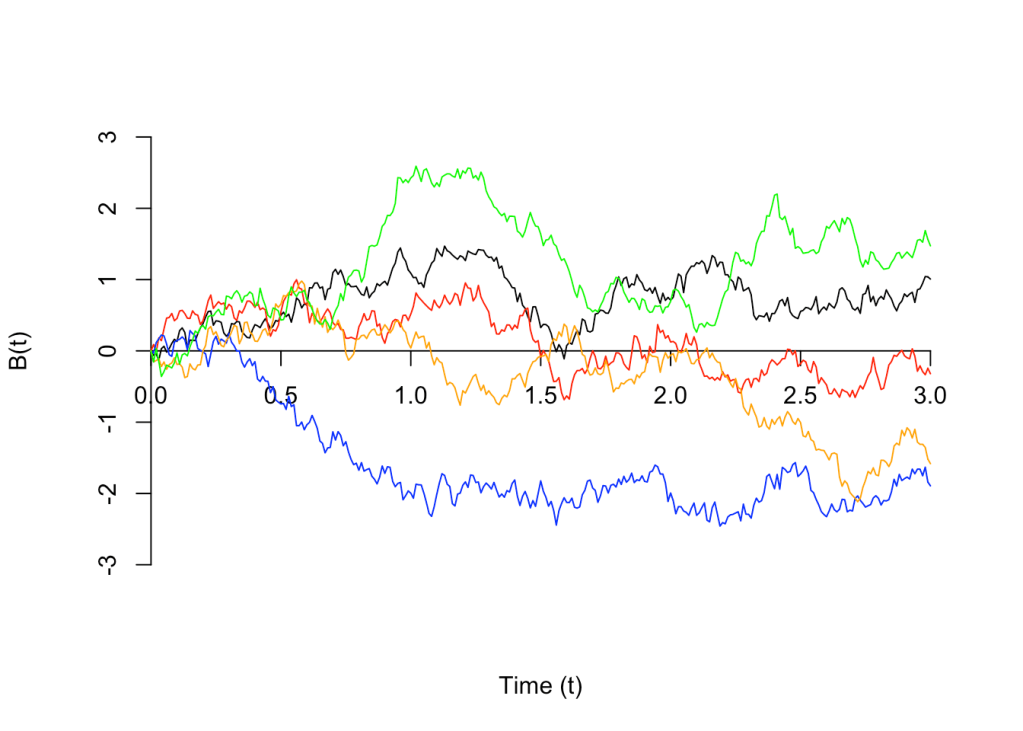
Samples of the trajectories of the Brownian motion.
The Brownian motion 


for any 

![\displaystyle\mathbb E \bigg[\sup_{s,t\ge 0} \frac{|B_t - B_s|^2}{t-s} \bigg]\le 1](https://s0.wp.com/latex.php?latex=%5Cdisplaystyle%5Cmathbb+E+%5Cbigg%5B%5Csup_%7Bs%2Ct%5Cge+0%7D+%5Cfrac%7B%7CB_t+-+B_s%7C%5E2%7D%7Bt-s%7D+%5Cbigg%5D%5Cle+1&bg=ffffff&fg=000&s=0&c=20201002)
but this is absolutely incorrect because it changes the order of the expectation and the supremum.
The correct way to prove the continuity is to observe that for any positive integer 


for any 

Finally, since 
Karhunen-Loève expansion
The Brownian motion has an alternative expression, the Karhunen-Loève expansion. The Brownian motion

where 

Consider the stochastic process
given by
,
where
are a set of functions satisfying
for any
and
, then for any positive integer
As a consequence,
is
.


Proof By direct calculation, we have

Here, the odd power of 


Here, 

To prove the inequality, divide the summation in the LHS into two parts.

and thus we obtain the desired result.
Summary
We employ the Kolmogorov continuity theorem to obtain the Hölder continuity of the Brownian motion and a general class of stochastic processes. Readers can also refer to Lemma 3.2 of my recent paper for an interesting application of the result.
 Xuda Ye
留下评论